Worried About a Recent Arrest?
Search by name and state to check available arrest, mugshot, jail, booking, and court report options.
Enter first name, last name, and state.
Arrests.Org Texas: Search, Verify & Remove Mugshots — Complete 2026 Guide
If you found a Texas arrest listing online, do not stop at a mugshot page. This guide explains how to verify the record through official county jail, court, DPS, TDCJ and notification resources, how to avoid common mistakes, and how to request removal when a record is dismissed, sealed, expunged or inaccurate. Plain English. Verified links. Free options first.
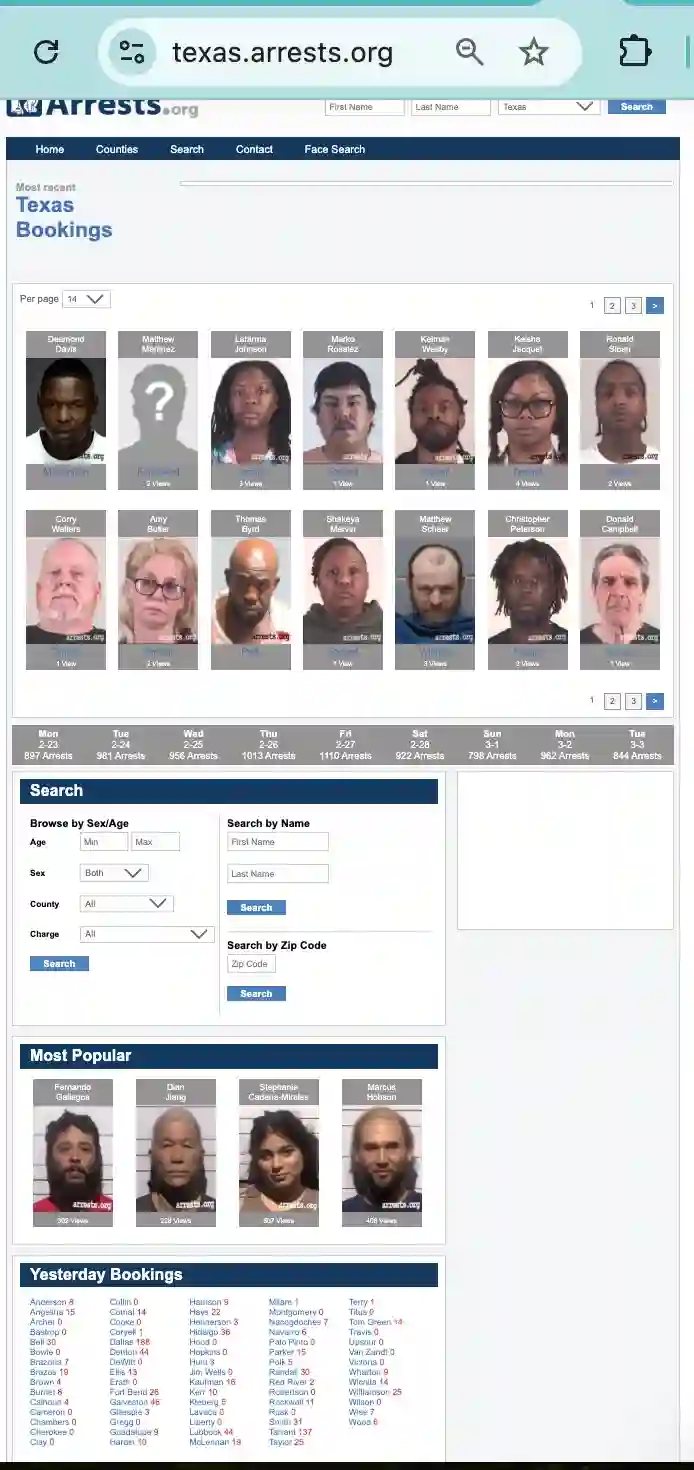

- What Arrests.org Texas is
- What this page should not be used for
- How to verify a Texas arrest
- County jail vs TDCJ vs courts vs DPS
- Major county jail search links
- Before you call a Texas jail
- Texas bail and bond basics
- Texas jail visitation
- Money, phone calls, mail
- Texas court case search
- Official DPS background checks
- Expungement and nondisclosure
- Mugshot removal steps
- 12 Texas insider tips
- Official resources
- Frequently asked questions
What Is Arrests.org Texas?
Arrests.org Texas is a privately operated website that displays arrest records, booking photos and basic charge information collected from public sources across all 254 Texas counties. It is not a Texas government portal, not a sheriff website, not a court website, and not a criminal-history agency.
The safest way to use it is simple: treat it as a clue, not as proof. If you find a listing, use the county name, booking details and charge information to locate the official county sheriff, jail, court or state database. Only official records should be used for current custody, bond, court hearings, final case outcomes, and background-check decisions.
What This Page Should Not Be Used For
Because arrest data can be incomplete, old or misunderstood, this page should never be used as a final decision-making tool.
- Do not use a mugshot listing to decide that someone is guilty. An arrest is not a conviction. Many cases end in dismissal, no-bill from the grand jury, deferred adjudication or acquittal.
- Do not use this page for FCRA-regulated decisions. Employment, housing, lending, insurance, licensing or eligibility screening must use FCRA-compliant background-check providers, not mugshot aggregators.
- Do not harass, shame, threaten or contact people because of an arrest listing. Texas has anti-harassment statutes and civil tort remedies that protect arrestees from misuse of their booking photos.
- Do not assume old third-party pages reflect current court status. Mugshot sites rarely update when charges are dropped or sealed.
- Do not pay a “guaranteed removal” service before checking your free and legal options. Texas Business & Commerce Code Chapter 109 makes pay-to-remove illegal in many cases.
How to Verify a Texas Arrest Record — Step by Step
If you found an arrest listing online, your next step is verification. Answer these four questions: (1) Is the person currently in custody? (2) What county handled the booking? (3) What is the current bond or court status? (4) Has the case been dismissed, filed, reduced, sealed or expunged?
- Identify the county first. Texas has 254 counties — more than any other state — and each manages its own jail records. If only the city is known, search “[city name] Texas county” to find the correct county. Some cities (Houston, Dallas, San Antonio, Austin) span multiple counties.
- Open the official county sheriff or jail website. Look for “Inmate Search,” “Jail Roster,” “Who’s in Jail,” “Jail Records,” “Magistrate Search” or “Booking Search.” Avoid ad-heavy private directories when you need current data.
- Search by full legal name. Use the person’s legal first and last name. If nothing appears, try partial last name, maiden name, hyphen variations, or date of birth if the official search allows it. Texas booking systems use SPN (System Person Number) in Harris County, CIDN in others — record whatever ID number is returned.
- Write down the booking details. Save the booking number / SPN / CIDN, charge with penal code (e.g., “Penal Code 22.01 – Assault Class A”), bond status, facility, court date, case number, and official source URL. These details help when calling the jail, court clerk, attorney or bondsman.
- Check the court record. The jail record shows custody and booking details. The court record shows case filing, hearings, disposition and final outcome. You need both for a complete picture. In Texas, district clerks handle felonies; county clerks handle misdemeanors.
- Register for VINELink alerts if needed. Free email or SMS notifications when custody status changes. Useful for release, transfer or escape alerts when families need updates without calling the jail repeatedly.
County Jail vs. TDCJ vs. Court Records vs. DPS
Many people search the wrong system first. This table explains where to go depending on the situation.
Texas charge severity — what the booking codes mean
Texas booking systems use specific charge classes. Knowing the class tells you the stakes immediately:
Major Texas County Jail Search — Official Links
Start with official county resources when you need current jail data. The 8 largest counties below cover roughly 65% of all Texas arrests. For other counties, scroll to the lookup pattern below.
How to find any other Texas county jail (for the remaining 246 counties)
- Search the county name + “sheriff inmate search”: Example — “Smith County Texas sheriff inmate search” or “Montgomery County TX jail roster”.
- Choose the official .gov, county, or sheriff domain. Avoid the first private aggregator — official sources are usually 2nd or 3rd in results.
- Look for the right page label: “Inmate Search,” “Jail Roster,” “Who’s in Jail,” “Booking Search,” “Magistrate Search,” or “Corrections.”
- Confirm by phone if urgent. If bond, release, medication, safety or travel is involved, call the jail using the official phone number listed on the county website.
Harris County Sheriff’s Office — primary jail location
This map is for general location reference only. Always confirm the exact facility, entrance, visitation rule and parking instruction before traveling.
Harris County Joint Processing Center
1200 Baker Street, Houston TX 77002 · Booking and processing for Harris County arrests
Before You Call a Texas Jail
Jail staff can usually help faster when you have the right details ready. Write these down before calling — booking sergeants take 100+ calls a day from frantic relatives, and the calm prepared callers get information first.
- Full legal first and last name (as on driver’s license — not nickname).
- Date of birth or approximate age range.
- County where the arrest likely happened — and the city if you know it.
- Booking number, SPN, or CIDN if available.
- Approximate arrest date and time (within 6-hour window helps narrow records).
- Charge or arresting agency if you know it (e.g., Houston PD, Harris County Constable Pct 4).
- Your relationship to the person (immediate family helps but not required for verification).
- Pen and paper ready for bond, court date, facility, visitation and mail details.
Texas Bail and Bond Basics
Bail rules vary by charge, county, criminal history and judge. In Texas, the person appears before a magistrate within 48 hours (often sooner). The magistrate may set a bond, deny bond for certain charges, release the person on personal recognizance (PR), or hold the case for further action.
Cash bond
You pay the full bail amount to the court or jail system. Refunded after the case ends if all court appearances are made.
Surety bond
You pay a licensed bondsman a non-refundable fee (typically 10% in Texas, sometimes 8% with shopping). Bondsman posts the full bond.
Personal bond / PR bond
Court releases on a written promise to appear. Sometimes with conditions (drug testing, electronic monitoring). No money up front.
No bond / hold
Magistrate hold, parole hold, warrant from another county, ICE detainer or capital charge. Speak with a lawyer immediately.
The five questions to ask every Texas bondsman before paying
- What is your premium rate, and are there any additional fees beyond it? Standard is 10% in Texas. Some bondsmen offer 8% to first-time defendants with verifiable employment.
- Is collateral required? For higher bonds ($25,000+), bondsmen often want a co-signer with property, vehicle title, or credit card hold.
- What triggers bond revocation or surrender? Missed check-in, failure to appear, new arrest, contact with co-defendants, or leaving the county can all trigger it.
- What is your estimated release time after I pay? Texas counties vary from 2 hours (Travis, Williamson) to 8+ hours (Harris during peak times).
- Are you licensed by the Texas Department of Insurance? Verify directly at tdi.texas.gov — “License Lookup”.
Texas Jail Visitation Basics
Most Texas jails require scheduling before any visit. The platform varies by county — common vendors include Securus, GettingOut/ViaPath, SmartJailMail and county-specific systems. Walk-in visits are almost always denied at large facilities.
- Confirm the person is still in custody before scheduling. Inmates can be transferred or released between booking and your visit.
- Check whether you must be on an approved visitor list. Most facilities require advance application with background check before first visit. Approval takes 5–14 days.
- Bring a valid government-issued photo ID. Texas driver’s license, state ID, passport, or military ID. Some facilities require ID issued in-state.
- Follow conservative dress code rules. No sleeveless tops, shorts above mid-thigh, see-through fabrics, or clothing similar to inmate uniforms (orange or white).
- Check whether children are allowed and what documents are required (birth certificate, parental ID, custody papers).
- Do not bring phones, electronics, tobacco, weapons or restricted items into secure areas. Lockers usually available outside the visitor entrance.
- Check your own warrants before visiting. Visitor IDs may be checked against active warrants — people are detained at the door regularly.
Sending Money, Phone Calls, and Mail
County jails and TDCJ facilities don’t all use the same vendor. Never assume one account funds everything. Commissary, phone calls, messaging and video visits may be separate.
Common Texas county jail vendors
Securus Technologies
Phone, video, messaging in Harris, Bexar, Tarrant, El Paso. Account at securustech.net.
GettingOut / ViaPath
Phone, video, messaging in Travis, Collin, Denton. Account at gettingout.com.
JPay (TDCJ)
Money deposits and email for TDCJ inmates. Account at jpay.com.
SmartJailMail / TextBehind
Some smaller Texas counties — digital mail processing. Check the county jail website.
Texas Court Case Search — Check the Real Status
A jail listing shows booking information. It does not show what prosecutors filed, whether the case was rejected, whether charges changed, or how the case ended. For that, check the court record.
- Find the right Texas court system. Felonies → district clerk. Misdemeanors → county clerk. Some counties combine them. Search “[County] Texas district clerk criminal case search” or “[County] county clerk criminal records”.
- Search by case number when possible. Texas case numbers usually start with court designation (e.g., “F” for felony district court, “MA” for County Criminal Court at Law). If you only have a name, use full legal name + date of birth.
- Review key dates and disposition. Look for filing date, charges filed (may differ from booking charges), arraignment, hearings, plea or trial outcome, dismissal, and final judgment date.
- Request certified copies when needed. For expungement, mugshot removal, or licensing applications, request a certified copy of the judgment or disposition order. Texas counties charge $5–$25 per certified copy.
Texas court portal links — major counties
Harris County District Clerk
Online case search for felonies. hcdistrictclerk.com
Dallas County Clerk
Misdemeanor and felony searches. dallascounty.org
Tarrant County Clerk
Combined criminal records search. tarrantcountytx.gov
Bexar County District Clerk
Combined civil and criminal. bexar.org/district-clerk
Travis County District Clerk
Online portal for felonies. traviscountytx.gov
re:SearchTX (statewide)
Free statewide court records search system. research.txcourts.gov
Official Texas Criminal History & Background Checks
If you need formal Texas criminal-history information, do not rely on mugshot websites. Texas DPS Crime Records is the official source. Depending on your purpose, you may also need fingerprints, court records, or a legally compliant FCRA background-check process.
Texas DPS Crime Records Service
The official Texas state criminal-history clearinghouse. Name-based search and fingerprint-based search options.
DPS Computerized Criminal History (CCH)
Online criminal-history name search. Account setup required. Pay-per-search ($3 per name).
FAST fingerprint background
Fingerprint-based identity-verified searches for licensing, employment, adoption — through DPS-approved IdentoGO sites.
FBI Identity History Summary
Federal record for nationwide arrest history — for immigration, federal employment, foreign travel.
Texas Expungement & Nondisclosure — Plain English
Texas has two different processes that may help clear, seal, or limit public access to certain records: expungement (Article 55.01 of Code of Criminal Procedure) and nondisclosure (Chapter 411 Subchapter E-1 of Government Code). They are not the same thing, and eligibility depends on the exact case history.
Which one might apply?
The Texas expungement process
- Confirm eligibility through Texas Article 55.01 of the Code of Criminal Procedure. The waiting periods vary: 180 days (Class C), 1 year (Class A/B), 3 years (felony) from the date of arrest if no charges were ever filed.
- Obtain a certified case disposition from the district clerk (felonies) or county clerk (misdemeanors).
- File a Petition for Expunction in the proper Texas court. Filing fee is typically $250–$350. Form templates available at TexasLawHelp.org.
- Serve all agencies that may have records: arresting agency, DPS, prosecuting attorney, central database, and any other agency that may have been notified.
- Attend the expungement hearing if required. Most uncontested petitions are approved in one hearing.
- After court signs the order, use the certified expunction order to demand removal from all mugshot sites, background-check vendors, and DPS databases.
How to Request Mugshot Removal or Correction
Do not pay a removal service first. Start by collecting proof of the case outcome and using the website’s own removal or contact process. If a page remains online after a record is sealed, expunged, confidential or inaccurate, Texas Business & Commerce Code Chapter 109 gives you a direct legal remedy.
- Save the listing details first. Copy the exact page URL, record ID if shown, county, arrest date, name spelling, and screenshots. You’ll need these for the removal request and for any escalation.
- Get official court paperwork. Request a certified disposition, dismissal order, expunction order (Article 55.01), nondisclosure order (Chapter 411), or other official proof from the court clerk. Cost: typically $5–$25 per certified copy.
- Use the site’s removal or contact form first. If the site provides a removal link, use it. Make sure you are on the correct website domain before uploading documents.
- Do not send more private data than needed. Redact your Social Security Number, driver’s license number, and any unrelated case numbers using a solid black box (not a white box overlay — those can be reversed).
- Follow up in writing. Keep copies of every request, email, screenshot and response. Written proof helps if you need to escalate to the Texas Attorney General or file suit under Chapter 109.
- Request search engine cache removal after the page changes. If the page shows 404 (gone) but still appears in Google or Bing, use Google’s Remove Outdated Content tool and Bing’s Content Removal tool.
Escalation timeline if the publisher refuses
12 Texas Insider Tips That Actually Matter
Twelve non-obvious tactics drawn from Texas Code of Criminal Procedure, county jail practice, FTC enforcement actions, and Texas-specific statutes — small details that separate a wasted week from a clean record.
Under Code of Criminal Procedure Art. 15.17, magistrates must inform arrestees of charges and bond within 48 hours of arrest. Most Texas counties hold magistrate court 2–3 times per day. Houston (Harris) and Dallas run them every 4 hours. Showing up at the courthouse with bail-ready cash can speed release dramatically.
Texas CCP Article 17.151 forces release on personal bond if the State is not “ready for trial” within 90 days (felony) or 30 days (Class A/B misdemeanor) of detention. This is one of the most under-used remedies in Texas — most public defenders will file an Art. 17.151 motion if reminded.
Texas allows competitive bondsman premiums. While 10% is standard, large urban bondsmen in Houston, Dallas, Fort Worth, San Antonio, and Austin frequently offer 8% to first-time defendants with verifiable employment. On a $20,000 bond, that’s $400 saved. Always shop at least 3 bondsmen.
Harris County uses two parallel ID systems: SPN (System Person Number) for jail/sheriff, and CIDN (Court Identification Number) for the district clerk. The same person has both, but they’re not interchangeable. Always record both when calling — they speed lookup time at the courthouse and bondsman office.
Class C misdemeanor dismissals (no jail penalty) qualify for expunction after 180 days — the fastest expunction wait in Texas. Most clerks won’t tell you this. File petition exactly on day 181. Outcomes are nearly automatic for documented dismissals.
Most felony deferred adjudications require a 5-year wait before nondisclosure (sealing). Most misdemeanor deferred adjudications: 2 years. Class C misdemeanor deferred: immediate eligibility. Government Code § 411.0726–411.0727 has the exact charge breakdown.
DPS abolished the DRP in September 2019, eliminating surcharges for DWI, no insurance, and accumulated points. However, debt that was already owed can still appear on driving records. Request a free Driver Eligibility Check through DPS to confirm surcharge status.
If someone runs from police in Texas, even briefly, the state can add an “evading arrest or detention” charge under Penal Code 38.04 — state jail felony if a vehicle is used. This commonly upgrades a Class B misdemeanor stop into a felony booking. Knowing this charge exists helps in plea negotiations.
Most Texas county jails sign exclusive contracts: Securus (Harris, Bexar, Tarrant, El Paso) or GettingOut/ViaPath (Travis, Collin, Denton). The provider locks the inmate’s phone account; you cannot use a competitor. Set up the right vendor account on day 1 — calls drop without a balance.
If charges were never filed but the arrest record still appears, Texas Gov. Code § 411.0719 allows nondisclosure of the arrest record itself (separate from any conviction). Few attorneys file these; even fewer arrestees know they exist. Especially powerful when an aggregator like Arrests.org Texas keeps publishing an arrest with no case outcome.
If your Texas DPS criminal-history record contains errors (wrong charges, wrong disposition, wrong identity), file a DR-1 review request with Texas DPS Crime Records. Free; takes 6–10 weeks. Usually resolves wrong-person identity-theft arrest entries that mugshot sites also republish.
Texas Bus. & Com. Code § 109.005 allows $500 per day in statutory damages against publishers that refuse to remove records after receiving notice of dismissal, expunction, or sealing. Plus attorney’s fees. This is one of the strongest mugshot-removal statutes in the country — many Texas attorneys take these cases on contingency.
Official Resource Directory
Verified primary resources for verification, complaints, and removal action.
Frequently Asked Questions
No. Arrests.org Texas is a private third-party website. It is not operated by a Texas sheriff, court, TDCJ, DPS or any government agency.
No. An arrest listing is not proof of guilt. Charges may be dismissed, declined, reduced, sealed, expunged or resolved without a conviction.
Use the county, booking date and charge details as clues. Then verify the record through the official county sheriff, jail, court clerk, DPS, TDCJ or VINELink resource.
Identify the county first, then search the official sheriff or county jail website. If the arrest is very recent, wait 4–8 hours and check again — Texas booking data lags by a shift change.
Use the official TDCJ Offender Search. It is for people currently incarcerated in TDCJ facilities, not every person arrested in a county jail.
Check the district clerk (felonies) or county clerk (misdemeanors) for the county where the case was filed. Or use re:SearchTX for statewide search.
Yes — start with the publisher’s removal process and provide official proof such as a certified dismissal, expungement order under Article 55.01, or order of nondisclosure. Texas Business & Commerce Code Chapter 109 prohibits fees for removal.
It is a Texas law chapter that regulates business entities publishing criminal record information. It prohibits charging fees to remove inaccurate, sealed, expunged or confidential records, and provides $500/day statutory damages plus attorney fees.
No. Do not use this page or a mugshot aggregator for employment, housing, lending, insurance or formal screening decisions. Use FCRA-compliant background-check processes through licensed CRAs.
No. Jail calls, video visits, messages and mail may be monitored or recorded. Do not discuss case facts, evidence, witnesses or legal strategy through jail communication systems.
VINELink helps users search custody status and register for free email or SMS notifications when an inmate’s custody status changes. Useful for release, transfer or escape alerts.
Get official court records and, if needed, speak with a Texas attorney or legal aid resource through Texas Law Help. Do not rely only on a private mugshot page.